Scroll to the bottom for new laws that may help you.
If you are being evicted, we want to help you, even if we don’t get paid. If you are in Bakersfield and are low-income, you should consider calling Greater Bakersfield Legal Assistance at (661) 325-5943 or contacting them through their web page at GBLA.org. For those who qualify, GBLA may provide free services, including the services of an attorney.
If you are the victim of a slumlord, call us. We might be able to introduce you to an attorney who will sue your landlord for failing to provide habitable property.
If GBLA can’t help you and you don’t qualify for a habitability case, call us for help preparing paperwork to get your matter in court in front of a judge. The paperwork we prepare can often be used to defeat an unlawful detainer or slow the proceedings down long enough for you to find a new place to live.
New Laws for 2026
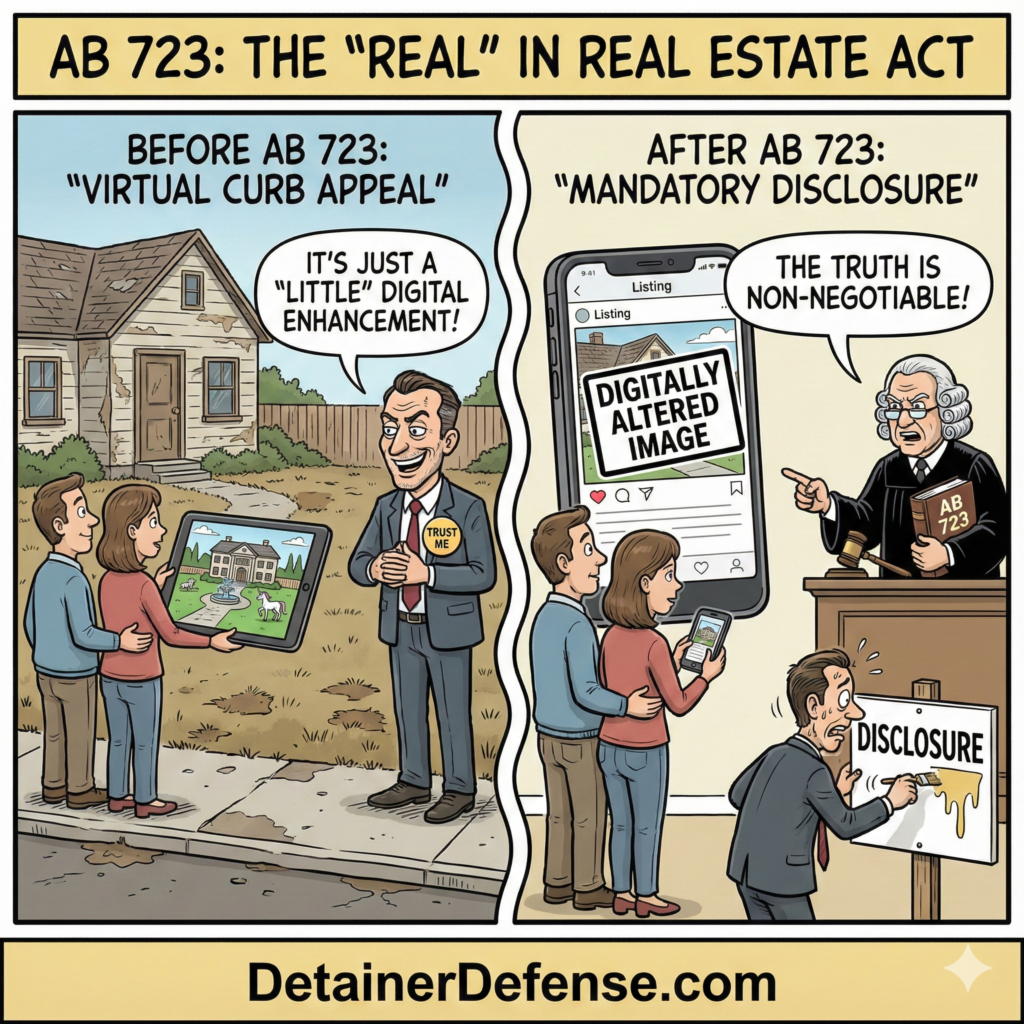
California Assembly Bill 723 (AB 723) mandates that any person who distributes or publishes an advertisement for the sale or lease of real property containing a digitally altered or virtually staged image must include a clear and conspicuous disclosure stating that the image has been modified. This disclosure is required if the alteration alters the property’s physical characteristics, such as the condition of the yard, the color of the walls, or the presence of furniture. The law aims to prevent consumer deception by ensuring prospective buyers and tenants understand when a photo does not accurately reflect the property’s current physical condition.
California Assembly Bill 628 (AB 628) expands state habitability standards by requiring landlords to provide and maintain a working stove and refrigerator in residential rental units for all leases entered into, amended, or renewed on or after January 1, 2026. Under this law, a dwelling is deemed untenantable if it lacks a stove capable of safely generating heat for cooking or a refrigerator capable of safely storing food, and landlords are specifically mandated to repair or replace any such appliance subject to a manufacturer’s recall within 30 days of notice. While the mandate is generally mandatory, tenants may mutually agree to provide and maintain their own refrigerator if the lease includes specific legal disclosures and allows the tenant to request a landlord-provided appliance later with 30 days’ written notice. The bill provides narrow exemptions for specific housing types, such as permanent supportive housing and single-room occupancy units with communal kitchens. Otherwise, it elevates these kitchen appliances to the same legal status as essential utilities like heat, water, and plumbing.
Senate Bill 655 establishes a landmark state policy in California that all residential dwelling units must be capable of maintaining a safe maximum indoor temperature to protect residents from extreme heat. While the law does not immediately mandate specific air conditioning installations for all existing buildings, it requires state agencies, including the Department of Housing and Community Development (HCD), to incorporate these safe cooling standards into formal building regulations and habitability codes starting January 1, 2027. By elevating indoor cooling to a matter of state policy alongside existing heating requirements, the bill creates a legal framework to treat extreme heat as a serious habitability defect, ensuring that future housing infrastructure is resilient enough to serve as a safe refuge during severe heat waves.
California Assembly Bill 414 (AB 414), signed into law in 2025 and effective January 1, 2026, modernizes the process for returning residential security deposits by requiring landlords to issue refunds electronically if they accept any rental or security payments electronically. Under this law, which amends Civil Code Section 1950.5, landlords must notify tenants in writing of their right to receive their security deposit electronically. They must default to this method unless the landlord and tenant designate another method of return via a written agreement. Additionally, the bill streamlines administrative procedures by allowing parties to agree at any time during the tenancy—rather than only after a move-out notice—on how the itemized statement of deductions and the remaining deposit will be delivered. For tenancies involving multiple adult residents, the law mandates that the refund be issued as a single payment made payable to all tenants on the lease, unless all such tenants provide written consent to a different arrangement.
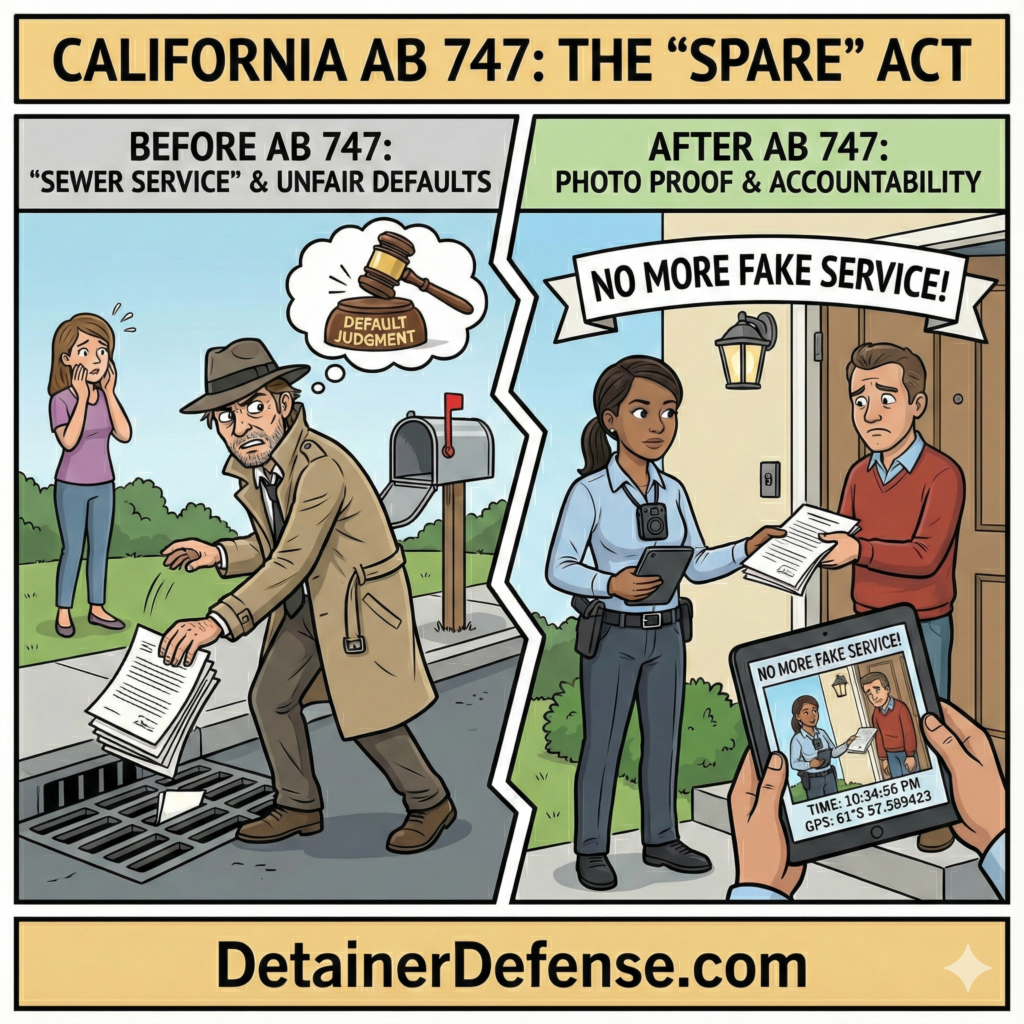
Assembly Bill 747, known as the Service of Process Accountability, Reform, and Equity (SPARE) Act, significantly strengthens protections for defendants, particularly in eviction and debt collection cases, by establishing rigorous new standards for the service of legal documents. The law aims to eliminate “sewer service” by requiring process servers to include photographic evidence with GPS coordinates and timestamps in their proofs of service and by mandating at least three good-faith attempts on different days and times before substituted service is permitted. Furthermore, the bill shifts the legal burden to the plaintiff to prove by a preponderance of the evidence that service was lawful if challenged. It allows defendants to move to vacate a default judgment void for lack of proper service at any time, ensuring that those who were never properly notified of a lawsuit have a meaningful path to defend their rights.
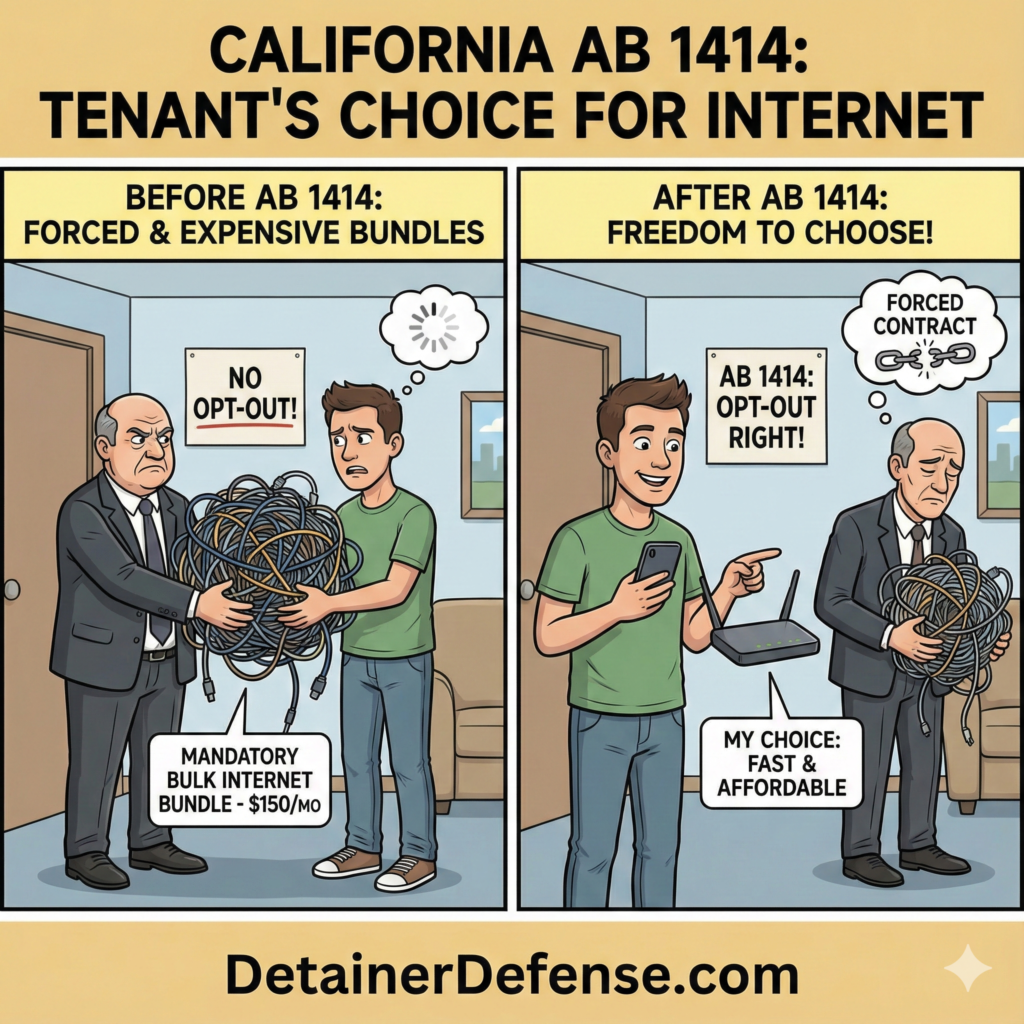
California Assembly Bill 1414 (AB 1414) prohibits landlords from requiring tenants to pay for mandatory, bundled internet service provider (ISP) subscriptions. This law, which adds Section 1942.8 to the Civil Code, requires that, for any new, renewed, or periodic residential tenancy, landlords must allow tenants to opt out of third-party internet service, including those provided through bulk-billing arrangements, without penalties or retaliation. If a landlord violates these provisions by refusing an opt-out request or continuing to charge for the service, the tenant is legally authorized to deduct the subscription cost from their rent. While the bill does not prevent landlords from offering bulk-billed internet as an optional amenity, it requires that renters have the freedom to choose their own internet provider or decline the service altogether to avoid unwanted fees.